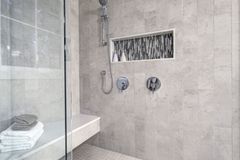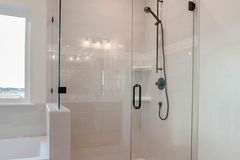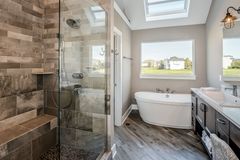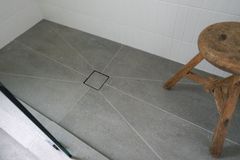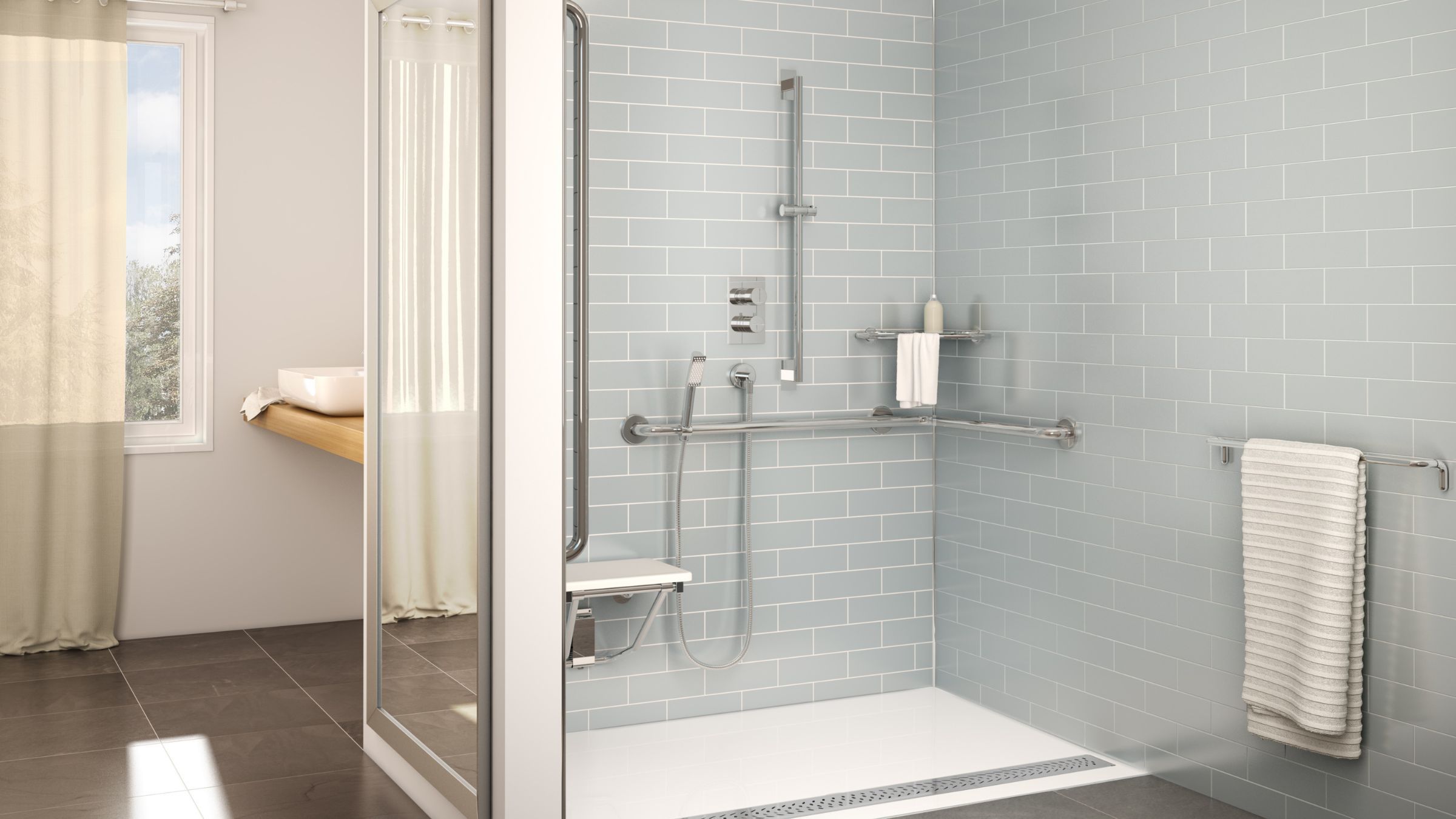
A walk-in shower replaces a stepped-over threshold with a low one or none at all. That single change drives most of what’s good and most of what’s difficult about them.
What they’re good at
Getting in and out. No tub wall to step over. For anyone with limited mobility this is the entire point, and it’s why walk-in showers are the standard answer when someone wants a bathroom that will still work in fifteen years.
Cleaning. Fewer edges, fewer tracks, and no shower curtain to replace. A frameless or open layout has very little that collects residue — although clear glass shows every water spot, which is its own kind of upkeep.
The room feels larger. Removing a tub and a curtain removes two visual barriers. A small bathroom often reads noticeably bigger with an open shower in it, without changing a single dimension.
Design flexibility. The footprint isn’t dictated by a standard tub size, so an awkward room can get a shower shaped to fit it.
What’s genuinely harder
Water control. An open shower depends on depth, slope and spray direction rather than on a barrier. Get those right and it’s a non-issue; get them wrong and you have a wet floor twice a day. See stop water splashing out.
Warmth. Open showers make the whole room’s temperature and airflow matter. Fixable, but it needs deciding at layout — are walk-in showers cold.
Cost. $6,000 to $15,000 for a custom tile walk-in against $1,500 to $6,000 for a fiberglass or acrylic tub-shower unit, per the EstimationPro.AI construction cost dataset, 2026. Some of that gap is quality and some is that a tiled wet area is simply more construction.
Losing the tub. If it’s the only bath in the house, that’s a real consideration — for washing small children, for anyone who baths rather than showers, and for resale in family housing. We won’t put a number on that last one; it depends entirely on your market and your buyer.
The comparison in one place
| Walk-in shower | Tub-shower combo | |
|---|---|---|
| Entry | Low threshold or none | Step over the tub wall |
| Typical project | $6,000–$15,000 tiled | $1,500–$6,000 unit |
| Water control | Depends on layout | Contained by the tub |
| Cleaning | Fewer edges, more glass | More corners, curtain or track |
| Bathing | No | Yes |
| Feels | Open | Enclosed |
Who each suits
A walk-in makes sense when accessibility matters now or is likely to, when the bathroom is small enough that openness helps, when nobody in the household baths, or when there’s another tub elsewhere in the house.
Keeping a tub makes sense when it’s the only one, when there are small children, or when the budget is the binding constraint — a tub-shower unit is a fraction of a tiled walk-in and there’s no shame in that being the reason.
The half-measure worth knowing about
A tub-to-shower conversion — removing the tub and building a tiled shower in its existing footprint — runs $2,000 to $10,000, typical $4,500. It’s substantially cheaper than a new shower elsewhere because the plumbing doesn’t move.
If a walk-in is what you want and cost is what’s stopping you, converting the existing tub alcove is usually the shortest distance between the two.
For what drives the number, see walk-in shower cost. For modelled totals by bathroom size and market, see the walk-in showers cost guide.