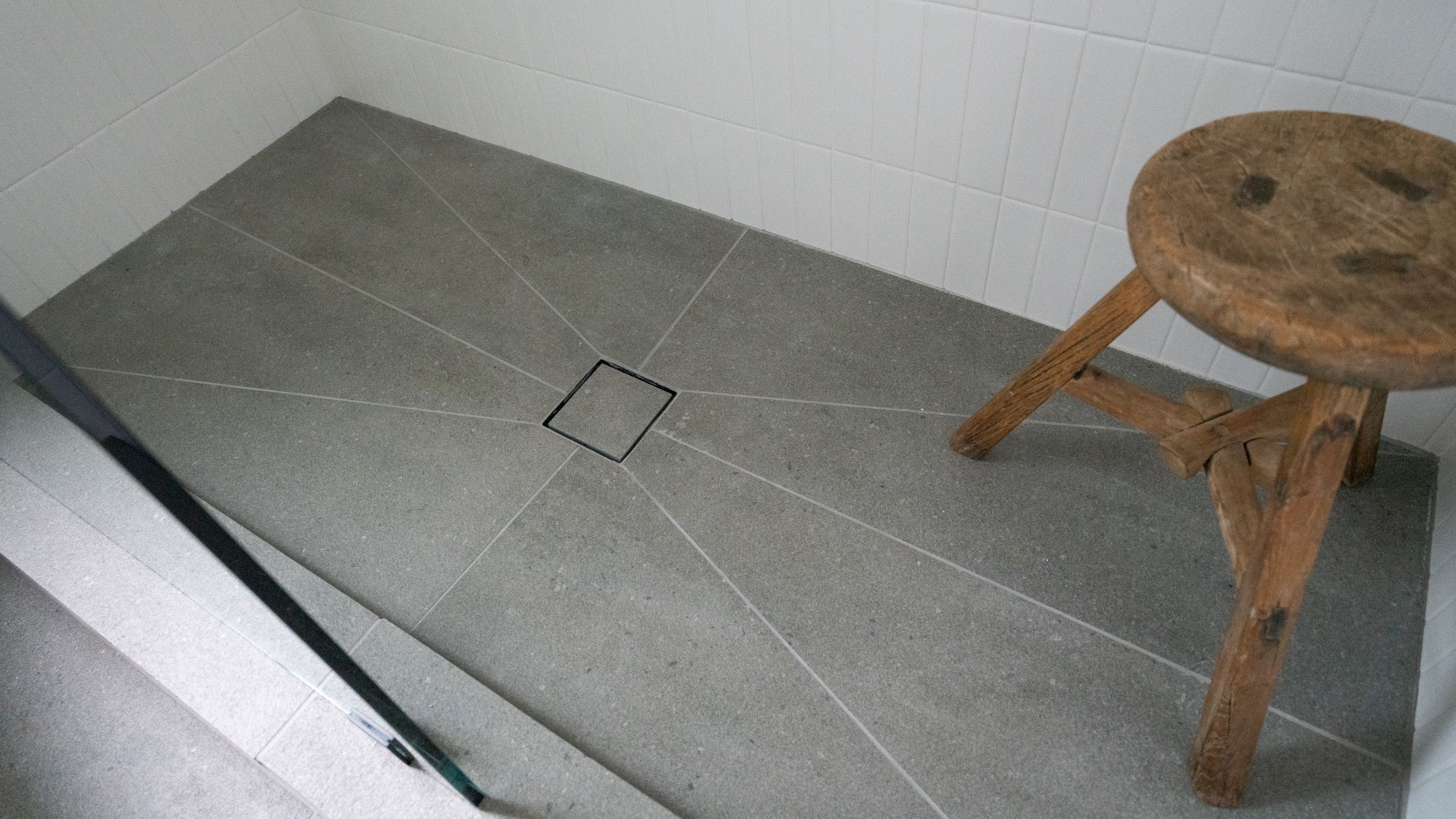
Water escaping a walk-in shower is a design problem, not an inevitability of open showers. Four causes account for nearly all of it, and three can be fixed without touching the shower itself.
Why it happens
The floor doesn’t drain fast enough. A shower pan needs a consistent fall to the drain — enough that water reaches it quickly rather than spreading. Too shallow a slope and water travels sideways before it goes down. This is the most common cause and the hardest to fix after the fact.
The head sprays toward the opening. Water bounces off you and off the floor, and its direction follows the spray. A head aimed at the entry sends splash straight out.
The volume is too high for the space. Rain heads and high-pressure settings put more water into a small area than the pan can clear.
The shower isn’t deep enough. Depth is what separates the wet zone from the room. A shallow walk-in is asking the drain to do work that geometry should be doing.
Fixes that don’t need a remodel
Reaim the head. Point it toward the back wall rather than the opening. On a fixed head that may mean a swivel adapter; on a handheld it’s free.
Lower the flow. A restrictor or a lower-flow head reduces the volume the pan has to clear. Most people don’t notice the difference in feel.
Add a threshold strip. A flexible silicone dam adhered to the floor at the opening forms a low ridge — enough to hold water back, low enough to walk over and, importantly, low enough not to be a trip hazard for someone with limited mobility.
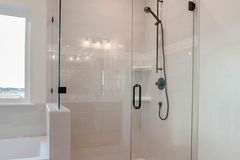
Add a fixed panel. A glass return panel at the wet side blocks the splash path without enclosing the shower. At $400 to $1,200 installed per the EstimationPro.AI construction cost dataset, 2026, it’s the most effective single change and the one most people end up making.
Use a weighted curtain. Less elegant, genuinely effective, and reversible. A curtain with a weighted hem against a return panel controls water about as well as a door.
Fixes that need the shower opened up
Correcting the slope. If the pan doesn’t fall properly, everything else is compensation. This means removing the floor and rebuilding the pan, so it’s worth confirming before you assume it — pour a jug of water at the far corner and watch whether it heads for the drain or sits.
A linear drain at the entry. Placing the drain as a channel across the opening rather than a point in the middle intercepts water on its way out. It’s the standard solution in curbless showers and it works, but it’s a pan rebuild.
More depth. The most reliable fix, and the least available after the fact.
If you’re still designing
Get three things right and splash largely stops being a topic.
Depth over width. A shower deeper than it is wide keeps water in without any hardware. This is free at layout and expensive later.
Head opposite the opening, spraying inward.
Drain positioned to catch travel, not just to sit at a low point.
The same decisions that keep water in also keep draughts out — see are walk-in showers cold, which is the other half of the same layout question.
For the project as a whole, see walk-in shower cost and the walk-in showers cost guide.