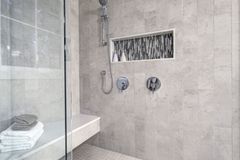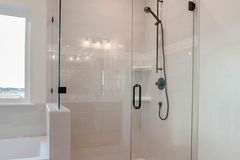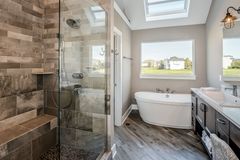
A custom tile walk-in shower runs $6,000 to $15,000. Most of the ways people try to reduce that either don’t save much or create a problem two years later.
A few genuinely work. The difference is whether you’re substituting a finish or skipping a layer.
Don’t move anything
This is the largest saving available and it’s a decision, not a purchase.
Bathroom plumbing rough-in runs $600 to $2,000 per fixture per the EstimationPro.AI construction cost dataset, 2026. Keeping the drain and supply where they are avoids that entirely, plus the framing and floor work that comes with relocating them.
A shower rebuilt in its existing footprint is a different order of project from one that moves three feet left. If the budget is tight, the layout is where you spend restraint.
Substitute the enclosure, not the waterproofing
The enclosure is the biggest optional line and the easiest to trade down.
- Frameless door: $800 to $2,500
- Semi-frameless: $500 to $1,500
- Fixed glass panel: $400 to $1,200
- Curtain with a rigid return panel: less again
A fixed panel in a walk-in layout does most of what a door does. A framed door seals better than a frameless one and costs less — it just has tracks to clean. See choosing a shower door for which suits your opening.
What you cannot trade down is what’s behind the tile. The waterproofing membrane is the layer that stops the wall rotting, it’s invisible when finished, and it’s the cheapest thing in the assembly to get right and the most expensive to get wrong.
Tile: where the money hides
Shower wall tile runs $10 to $30 per square foot installed, and a standard alcove has 80 to 100 square feet of wall. That’s a swing of roughly $2,000 between the ends of the range on tile alone.
Ceramic material runs $0.50 to $5 per square foot. Porcelain is $3 to $12. Natural stone is $5 to $25 and glass $7 to $35.
The saving is real, and so is the labour side: large-format tile adds $2 to $6 per square foot over standard, so a smaller, simpler tile in a standard format is cheaper twice over.
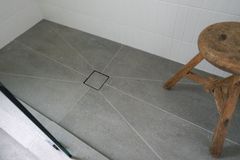
One place not to economise: the floor. A shower floor takes standing water and bare feet, and small-format tile gives more grout lines and better grip. It’s a small area, so upgrading it costs little.
Use the fixtures rather than skipping them
The per-item costs are small against the project, and they’re the things people cut first.
- ADA grab bar: $75 to $250
- Fold-down seat: $150 to $500
- Recessed niche: $150 to $500
A built-in tile bench is the genuine expense at $400 to $1,200, because it’s framed, waterproofed and tiled. A fold-down seat does much of the same job for a fraction, and can be fitted later.
Add blocking even if you skip the fixtures. Solid timber between studs where a grab bar might one day go costs almost nothing while the wall is open and is disproportionately expensive to retrofit. This is the single best value decision in a shower remodel.
What to leave to a professional
Two things.
The pan and the waterproofing. A pan that doesn’t fall correctly to the drain, or a membrane with a bad seam, produces a failure that is invisible until it’s structural. This is the part of the job where DIY savings turn into a rebuild.
Anything involving the drain. Slope, connection and venting are not places to learn.
Demolition, painting, fitting a curtain rail, changing a shower head and installing a fold-down seat into existing blocking are all reasonable homeowner jobs.
The order that saves money
- Keep the plumbing where it is
- Choose a standard-format tile you like
- Put the money into the pan and the waterproofing
- Add blocking everywhere you might ever want a fixture
- Trade the enclosure down, not the substrate
- Add the fixtures — they’re cheap
- Upgrade the floor tile, since it’s a small area
For the full picture, see walk-in shower cost. For modelled totals by bathroom size and market, see the walk-in showers cost guide.