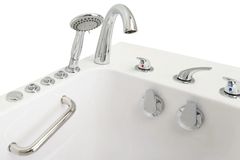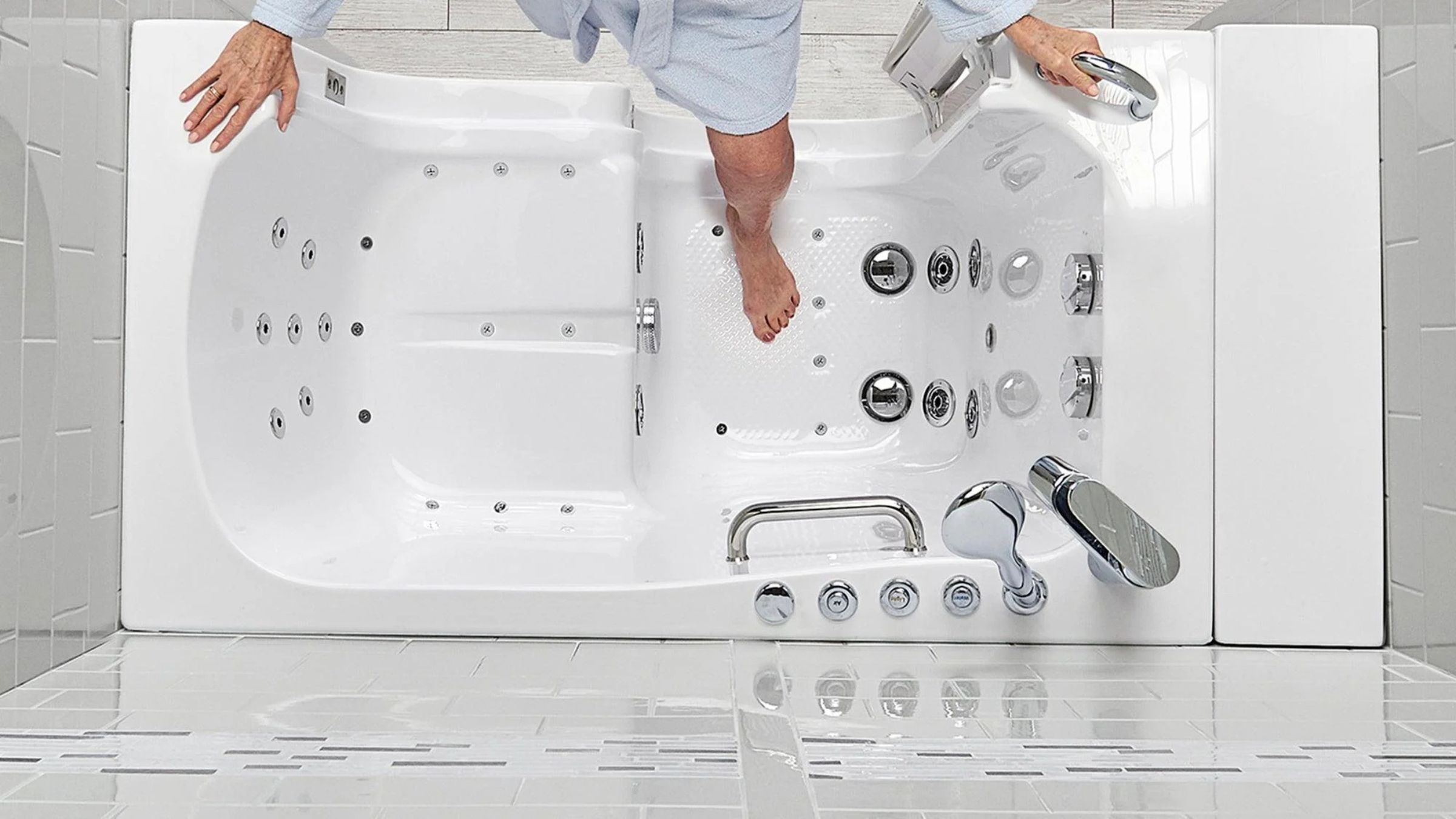
Both replace a bathing arrangement that requires stepping over a high tub wall. They solve it differently, and the right answer depends less on features than on two questions: do you want to bathe, and how low does the threshold need to be?
The threshold
This is the difference that matters most and gets discussed least.
A walk-in tub has a low threshold — typically a few inches instead of the fifteen or so on a standard tub. That’s a large improvement, and it is not zero.
A curbless walk-in shower can have no threshold at all. For a wheelchair user, or anyone who cannot reliably lift a foot over even a few inches, that distinction decides the question on its own.
If mobility is likely to reduce further, the shower is the arrangement that keeps working longest.
The bath
The walk-in tub’s reason for existing is that it lets you bathe seated, in water, with the door sealed. A shower cannot do that at any price.
For anyone who baths rather than showers — by preference, by routine, or because standing for the length of a shower is the actual difficulty — that is the whole argument, and no amount of shower design substitutes for it.
The waiting
A walk-in tub fills and drains with you inside it. Depending on the tub and your plumbing, that’s roughly 5 to 20 minutes filling and a further stretch draining, seated, before the door opens.
Some people find this unremarkable. Others find it the reason they stopped using the tub. It is worth picturing honestly before deciding — see the walk-in tub FAQ for the full cycle.
A shower has no equivalent wait.
Side by side
| Walk-in tub | Walk-in shower | |
|---|---|---|
| Threshold | Low — a few inches | Low or none at all |
| Seated bathing | Yes, in water | Seated showering only |
| Wait time | Seated through fill and drain | None |
| Wheelchair transfer | Possible with specific models | Straightforward when curbless |
| Water heater demand | High — one large draw | Ordinary |
| Electrical | Dedicated circuit for jetted models | None beyond normal |
| Typical project | Unit plus installation, priced separately | $6,000–$15,000 tiled |
| Footprint | Fits a standard tub alcove | Flexible |
Practical considerations either way
Water heater capacity is a walk-in tub question and rarely a shower one. A tub that fills lukewarm is a problem you can’t fix afterwards without replacing the heater.
Access for installation matters more for a tub — it’s a large rigid object that has to reach the bathroom intact.
Grab bars and seating apply to both. Blocking in the wall costs almost nothing during construction and is disproportionately expensive to retrofit, so specify it either way, even if you don’t want the bars yet.
Handheld shower fittings are standard on both and worth having on both.
How to decide
Choose a walk-in tub if bathing in water is the point, if the person using it can manage a few-inch threshold, and if the water heater can fill it.
Choose a walk-in shower if the threshold needs to be zero, if wheelchair transfer is a current or likely requirement, if waiting seated through a fill and drain sounds unappealing, or if the budget favours the simpler installation.
A conversion is the middle path. Removing an existing tub and building a tiled shower in its footprint runs $2,000 to $10,000, typical $4,500, per the EstimationPro.AI construction cost dataset, 2026 — cheaper than building elsewhere because the plumbing stays put.
For costs on each, see what does a walk-in tub cost and walk-in shower cost, or the walk-in tubs and walk-in showers guides.