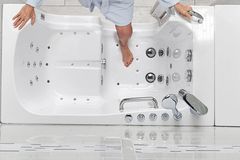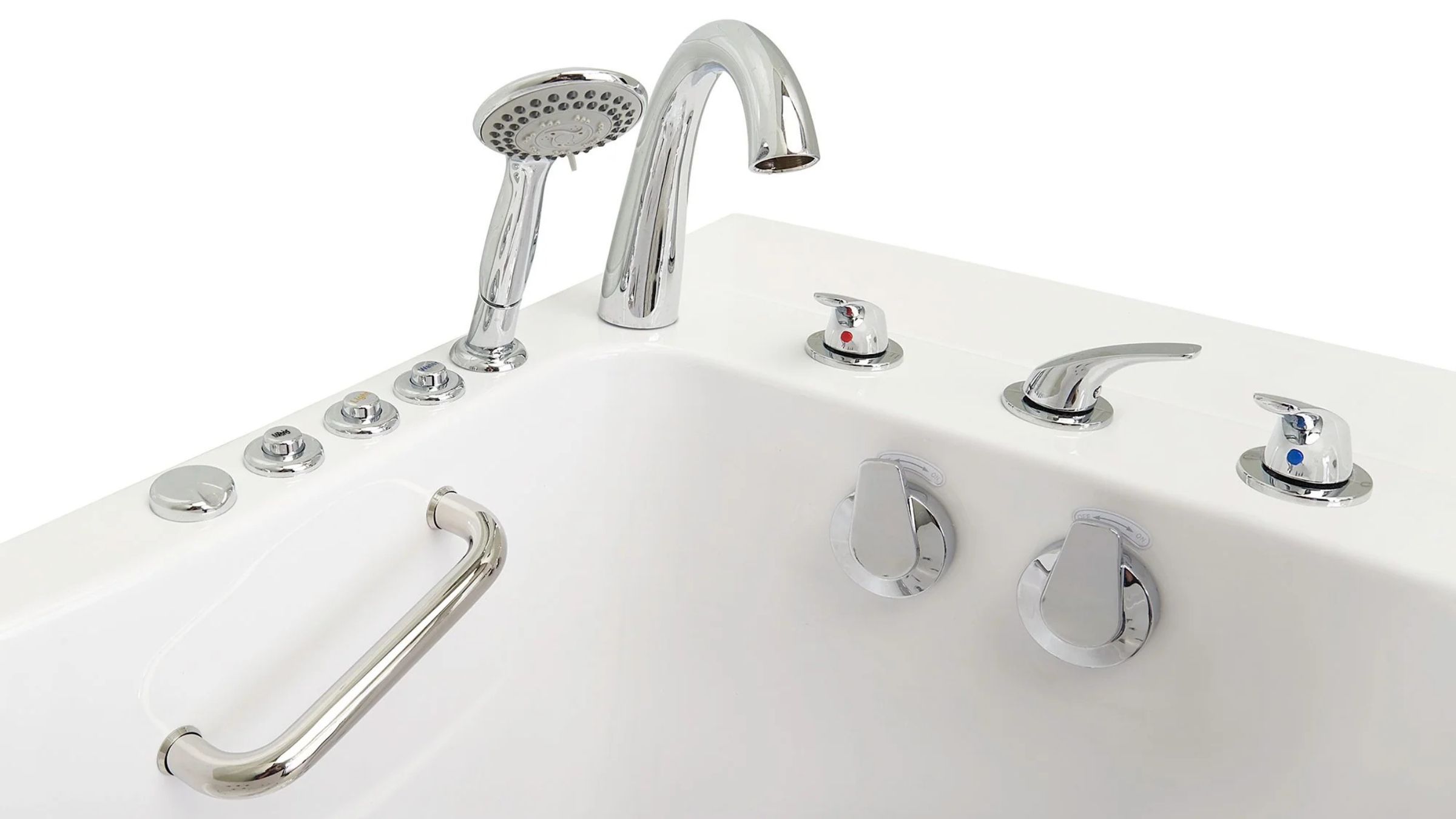
The defining practical fact about a walk-in tub is that you are inside it while it fills and while it drains. The door can’t open with water behind it, so both operations happen with you seated.
Everything below follows from that.
A walk-in tub bath, start to finish. You are seated inside for the fill and the drain, which is the part most people don't picture.
How long does it take to fill?
Typically 5 to 20 minutes. A standard walk-in tub holding around 40 gallons fills in roughly 5 to 10 minutes with average household water pressure. Larger tubs, low pressure or narrow supply lines push that toward 15 to 20.
Three things determine it: the tub’s capacity, your water pressure, and the diameter of the supply line feeding it. The third is the one most often overlooked and the easiest to improve — a larger supply line to the tub makes a real difference where pressure is adequate but delivery is restricted.
How long does it take to drain?
Standard drains typically take longer than the fill. Quick-drain or dual-drain systems — two outlets rather than one, or a pump-assisted outlet — cut it substantially, and they are the single upgrade most owners say they’d prioritise.
Drainage speed depends on tub capacity, pipe width and the drain system. Wider waste pipe drains faster; if your existing waste is narrow, that’s worth raising before installation rather than after.
Will I get cold waiting?
Possibly, and it’s worth planning for. You’re seated in an empty tub during the fill and a draining tub afterwards.
Two things help. Some models include a quick-fill or a pre-warm function that runs water over the tub surface first. And a heated bathroom matters more here than in any other bathing arrangement — a heated towel rail or radiant floor does more for the experience than any tub feature.
What size water heater do I need?
Enough to fill the tub to bathing depth in a single draw. A walk-in tub holds more water than a standard tub at seated depth, and a heater that can’t deliver it means the bath finishes lukewarm.
A 40-gallon heater is often cited as a minimum, but the correct answer is the tub’s stated capacity compared with your heater’s first-hour delivery — not its tank size. Ask for both figures before ordering.
This cannot be fixed afterwards without replacing the heater, which makes it the most important question on this page.
How is it installed?
Four common arrangements:
Corner — replacing an existing tub or shower in a corner. The most common.
Back-to-wall — a smaller tub against one wall, sometimes alongside an existing shower.
Side-to-wall — fitted between two walls, in an alcove or a panelled recess.
Free-standing — the existing bathing area removed entirely and a larger tub set in the space.
Most installations finish in one to two days. Longer if the tub is larger than what it replaces, if plumbing has to move, or if a jetted model needs a new electrical circuit.
Does the door leak?
A correctly installed door doesn’t. The seal depends on two things: the quality of the gasket, and the tub being set dead level. An out-of-level tub is the most common cause of a door that weeps, and it’s an installation fault rather than a product one.
Doors swing inward or outward by model. Inward-opening doors are sealed by water pressure and can’t open while full. Outward-opening doors allow a wider entry, which matters for wheelchair transfer, and rely on the latch and gasket alone.
Ask for a fill-and-drain test before the installer leaves. Any leak shows up in the first cycle.
What about the step?
Walk-in tubs have a low threshold rather than none — typically a few inches rather than the fifteen or so of a standard tub wall. It is a large improvement, not an elimination.
If a zero-threshold entry is the requirement, a curbless walk-in shower is the arrangement that provides it — see walk-in tubs versus walk-in showers.
What maintenance does it need?
Rinse and dry the door gasket regularly; a compressed or dirty gasket is what eventually leaks. Run jetted systems periodically even if unused, so lines don’t sit stagnant. Keep the drain clear, since a slow drain lengthens the part of the cycle nobody enjoys.
What does it cost?
The unit and the installation price differently — see what does a walk-in tub cost, and the walk-in tubs cost guide for modelled figures.